If you’ve been told you stop breathing at night, or if your partner hears you snoring like a freight train and gasping for air, chances are you’re dealing with sleep apnea. It’s more common than most people realize, and the effects go far beyond feeling tired the next day.
Left untreated, it can lead to heart issues, high blood pressure, memory problems, and more.
One of the most common treatments? Machines that help you breathe while you sleep CPAP and BiPAP.
They look similar and sound similar, but they’re not the same. So how do you know which one’s right for you?
What Is Sleep Apnea, and Why Is It a Big Deal?
Sleep apnea is when your breathing repeatedly stops and starts during sleep. Sometimes it’s because your airway gets blocked (this is called obstructive sleep apnea, or OSA). Other times, your brain doesn’t send the right signals to your breathing muscles (that’s central sleep apnea, or CSA). Some people even have a mix of both.
Why treatment matters
When you stop breathing during sleep even for a few seconds—your body jolts awake. This can happen dozens or even hundreds of times a night. You probably won’t remember it, but your sleep quality takes a major hit.
More importantly, your body doesn’t get the oxygen it needs. Over time, that can affect your heart, brain, mood, and energy levels.
That’s where breathing machines like CPAP and BiPAP come in.
What Is CPAP Therapy?
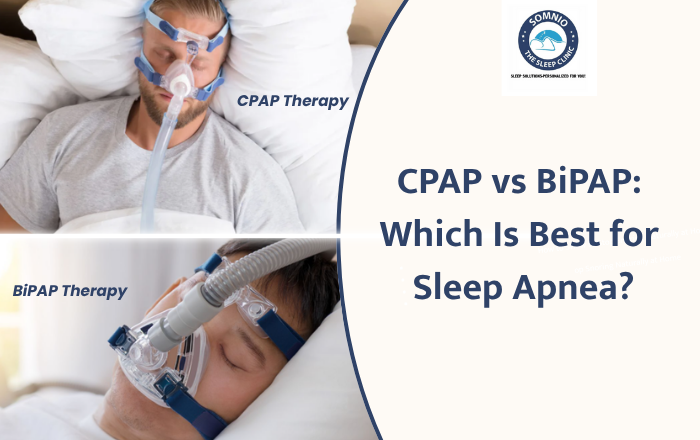
CPAP stands for Continuous Positive Airway Pressure. This machine sends a constant stream of air through a mask you wear while sleeping. That air keeps your airway open so you don’t stop breathing.
Who is CPAP usually for?
CPAP is the go-to therapy for most people with obstructive sleep apnea especially if it’s mild or moderate.
What CPAP is good at
- Helps prevent airway collapse
- Proven track record for treating OSA
- Machines are widely available
- Usually the first recommendation after a sleep study
What some people struggle with
- Constant pressure can feel uncomfortable
- Exhaling against the airflow may be hard for some
- Takes time to get used to the mask and routine
What Is BiPAP Therapy?
BiPAP stands for Bilevel Positive Airway Pressure. Unlike CPAP, BiPAP has two pressure levels:
- One for inhaling (higher pressure)
- One for exhaling (lower pressure)
This change in pressure makes it easier to breathe out, especially for people who have trouble exhaling against the fixed pressure from a CPAP machine.
When BiPAP is considered
- If CPAP didn’t work or was too hard to tolerate
- For people with central sleep apnea or more complex cases
- For people with certain lung or heart conditions
Why some people prefer BiPAP
- Breathing feels more natural
- Easier to adjust to for some patients
- May help if you need higher pressure settings
- Often used in hospital settings but available for home use too
CPAP vs. BiPAP: What’s the Actual Difference?
| Feature | CPAP | BiPAP |
|---|---|---|
| Pressure type | Constant pressure | Two pressure levels (inhale & exhale) |
| Best for | Obstructive sleep apnea | Central/complex sleep apnea, or CPAP-intolerant users |
| Comfort level | May feel harder to exhale | Easier breathing cycle |
| Cost | Usually lower | Often higher |
| Noise level | Generally quiet | Similar, sometimes a bit louder |
| Machine complexity | Simple to operate | Slightly more features and settings |
Which One Should You Use?
The short answer: it depends on your type of sleep apnea, your comfort with the machine, and how your body responds.
You might do well with CPAP if:
- You’ve been diagnosed with obstructive sleep apnea
- You’re new to therapy and trying it for the first time
- You don’t have major problems exhaling against the pressure
You might need BiPAP if:
- CPAP feels too uncomfortable or hard to adjust to
- You’ve been diagnosed with central sleep apnea
- Your doctor says you need higher pressure settings
- You have underlying heart or lung problems affecting your breathing
Ultimately, your sleep study results and how you feel using the machine will guide the decision.
Tips for Sticking With CPAP or BiPAP
Starting sleep apnea therapy is a big shift. Most people don’t love wearing a mask at first. Here’s how to make it easier:
- Pick the right mask – Full-face, nasal, or nasal pillow—test different types to see what feels comfortable
- Use the ramp-up feature – Most machines let you start at a lower pressure and gradually increase
- Clean your equipment – Daily or weekly cleaning helps avoid skin irritation or infections
- Be patient – It might take a week or two to get used to the machine. That’s normal
- Track your progress – Many machines sync with apps so you can see how much you’re sleeping and how effective the therapy is
Still Not Sure What’s Right for You? Talk to a Sleep Apnea Specialist
If all of this feels overwhelming, you’re not alone. CPAP and BiPAP are both helpful tools, but figuring out which one works best isn’t something you should guess.
If you’re in Hyderabad, one of the best places to get evaluated is Somnio The Sleep Clinic.
Dr. Sukhvinder Bindra and Dr. Gayatri Moghe have years of experience helping people breathe better at night. Whether you’re trying CPAP for the first time or switching to BiPAP, they can guide you through the process clearly and calmly.
👉 Ready to sleep better? Book your appointment with Somnio The Sleep Clinic in Hyderabad today.
Frequently Asked Questions
1. Is BiPAP always better than CPAP?
Not at all. BiPAP is helpful for some, but CPAP is still the most common treatment. It’s usually best to start with CPAP unless your doctor recommends otherwise.
2. How do I know if I need BiPAP instead of CPAP?
You might need BiPAP if CPAP feels too uncomfortable or if you have central sleep apnea, chronic lung issues, or very high pressure needs.
3. Can I just buy a CPAP or BiPAP machine online?
In many places, you need a prescription after a proper sleep study. That’s because the pressure settings need to be tailored to your needs.
Choosing between CPAP and BiPAP isn’t about picking the more expensive or “fancier” machine. It’s about what works best for your body and breathing patterns.
So don’t self-diagnose. Don’t guess. Talk to a sleep doctor who can help you understand your sleep study results and guide you to the right solution.
If you’re near Hyderabad, get in touch with Somnio The Sleep Clinic to consult a trusted Sleep Apnea Specialist in Hyderabad.
Let Dr. Sukhvinder Bindra and Dr. Gayatri Moghe help you take that next step toward deeper sleep and better health.