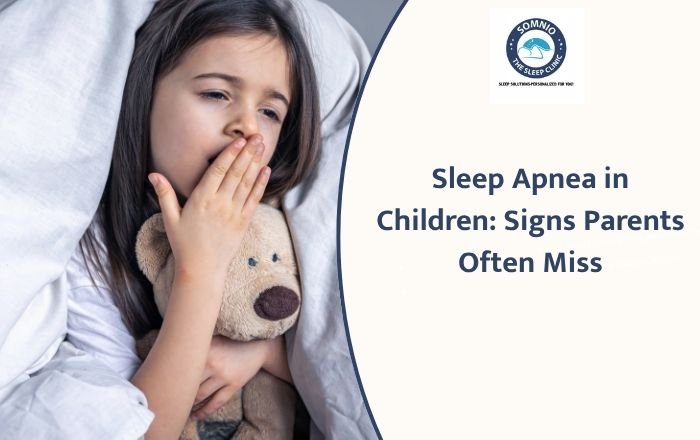
 Most parents peep in at a sleeping child and see a peaceful face. What they may not notice is the snoring every night, the open mouth, the restless tossing or the short pauses in breathing. Sleep apnea in children is often missed because many of its signs look like ordinary childhood habits, or show up as daytime behaviour problems instead of obvious sleep trouble.
This guide covers the signs parents often overlook, what causes them, and when to get your child checked.
What Is Sleep Apnea in Children?
Sleep apnea in children, also called pediatric obstructive sleep apnea (OSA), is a condition where the airway narrows or gets partly blocked during sleep, so breathing pauses again and again. Each pause disturbs sleep, even if the child does not fully wake up.
According to MedlinePlus, the most common reason is enlarged tonsils or adenoids. Other factors include a small jaw, the shape of the palate, a large tongue, obesity and low muscle tone.
Why Do Parents Often Miss the Signs?
Parents miss the signs because most of them happen while the family is asleep, and the daytime effects look like normal tiredness, naughtiness or a short attention span.
- Snoring is often seen as harmless or even cute
- Children rarely complain about poor sleep
- Tiredness in children can look like hyperactivity rather than sleepiness
- Symptoms may build up slowly over months
Which Night Time Signs Do Parents Often Miss?
The clearest clues appear at night. Spend a few minutes watching your child sleep, ideally an hour or two after they fall asleep.
1. Regular Loud Snoring
Light snoring during a cold is common. Snoring that happens most nights, is loud, or comes with snorts and gasps needs attention. Not every child who snores has sleep apnea, but regular snoring is worth discussing with a doctor.
2. Pauses, Gasps and Choking Sounds
Watch for silent gaps in breathing followed by a snort, cough or gasp. Some children also pull in at the chest while breathing in their sleep.
3. Mouth Breathing
A child who sleeps with the mouth open most nights may have a blocked nose, large adenoids or a narrow airway. Our article on whether mouth breathing in kids points to sleep apnea explains this in detail.
4. Restless Sleep and Odd Positions
Kicking, tossing, waking often, or sleeping with the head tilted far back can be the body’s way of trying to keep the airway open.
5. Night Sweats and Bedwetting
Heavy sweating during sleep and bedwetting, especially in an older child, are both linked with sleep apnea. Read more about bedwetting after age 7 and its link with sleep.
What Daytime Signs Point to Poor Sleep?
Children with sleep apnea often do not look sleepy. Poor sleep tends to show up in mood, behaviour and schoolwork instead.
- Hyperactivity or trouble sitting still, which can be mistaken for ADHD
- Irritability, mood swings or frequent tantrums
- Poor concentration and falling marks at school
- Difficulty waking up in the morning
- Daytime sleepiness, such as dozing off in the car or in class
- Slow growth or weight gain in some children
If a teacher mentions attention problems, it is worth asking how your child sleeps before assuming it is only a behaviour issue.
Which Children Are at Higher Risk?
Any child can develop sleep apnea, but the risk is higher in children who have:
- Large tonsils or adenoids
- Excess weight
- Frequent nasal blockage or allergies
- A small lower jaw, a narrow or high arched palate, or crowded teeth
- Conditions such as Down syndrome or cerebral palsy
- A family history of sleep apnea
Why Should Sleep Apnea in Children Not Be Ignored?
Untreated sleep apnea can affect a child’s growth, learning and long term health. Cincinnati Children’s notes that it can lead to problems at school and delayed growth if it is not diagnosed. Possible complications also include high blood pressure and heart or lung problems.
The encouraging part is that treatment often improves symptoms, which is why early evaluation matters.
How Is Sleep Apnea Diagnosed in Children?
Diagnosis starts with a detailed history and examination, and a sleep study is the test that confirms it.
- History: the doctor asks about snoring, sleep habits, behaviour and school.
- Examination: the nose, mouth, throat, tonsils, jaw and teeth are checked.
- Sleep study: an overnight sleep study test records breathing, oxygen levels and sleep, and shows how severe the problem is.
Tip for parents: record a short phone video of your child’s breathing and snoring at night. It can be very useful during the consultation.
What Are the Treatment Options?
Treatment depends on the cause, the child’s age and how severe the sleep apnea is. Options a care team may consider include:
- Removal of tonsils and adenoids, often the first treatment when they are enlarged
- Nasal steroid sprays or allergy care for a blocked nose
- Dental or orthodontic appliances, such as palatal expanders, for a narrow upper jaw
- Myofunctional therapy, exercises for the mouth and face muscles
- CPAP, a mask that gently pushes air to keep the airway open, when surgery is not suitable or does not fully help
- Weight management for children who are overweight
Every child is different, and results vary. Some children need more than one approach along with regular follow up.
Frequently Asked Questions
1. Is it normal for children to snore?
Light snoring once in a while, especially during a cold, is common and usually harmless. Snoring that happens most nights, is loud, or comes with pauses, gasps or restless sleep is not normal and should be checked. A doctor can then decide whether your child needs a sleep study or simply follow up.
2. At what age can children get sleep apnea?
Sleep apnea can affect children of any age, from infants to teenagers. It is often noticed in preschool and early school years, when tonsils and adenoids are large compared with the size of the airway. Older children and teenagers can also develop it, especially if they are overweight or have a narrow jaw.
3. Can sleep apnea cause behaviour problems in children?
Yes, it can. Poor quality sleep may show up as hyperactivity, irritability, poor focus or falling marks rather than obvious sleepiness, and these signs can be confused with ADHD. If your child has behaviour concerns and also snores or sleeps restlessly, mention both to the doctor.
4. Will my child grow out of sleep apnea?
Some mild cases may improve as a child grows, but it is not safe to simply wait and watch. Untreated sleep apnea can affect sleep, growth, learning and heart health. A proper evaluation helps decide whether your child needs monitoring or treatment, and how soon, based on the sleep study and examination.
5. Is a sleep study safe for children?
Yes. A sleep study is painless. Small sensors are placed on the skin, near the nose and on a finger to record breathing, oxygen levels and sleep. In many centres a parent can stay with the child overnight, and the team explains each step beforehand so the child feels at ease.
Get Your Child’s Sleep Checked at Somnio
Somnio The Sleep Clinic in Film Nagar, Hyderabad, was founded by Dr. Sukhvinder Bindra (MDS, Oral and Maxillofacial Surgeon) and Dr. Gayatri Moghe (MDS, Pediatric Dentist). Its team approach to sleep breathing problems in children includes airway and dental assessment, sleep studies when needed, and coordination with ENT specialists and pediatricians.
Phone: +91 99631 11550
Address: 2nd Floor, Babu Mohan Empire, 8-2-293/82/F, Plot No 21-C, Road No 9, Film Nagar, Hyderabad 500033
📍 Somnio The Sleep Clinic on Google Maps | Book a consultation