Do you wake up every morning feeling like you haven’t slept at all? Does your partner constantly nudge you because you’re snoring too loudly — or worse, gasping for air in the middle of the night? If this sounds familiar, you might be dealing with obstructive sleep apnea, and your jaw structure could be at the root of the problem.
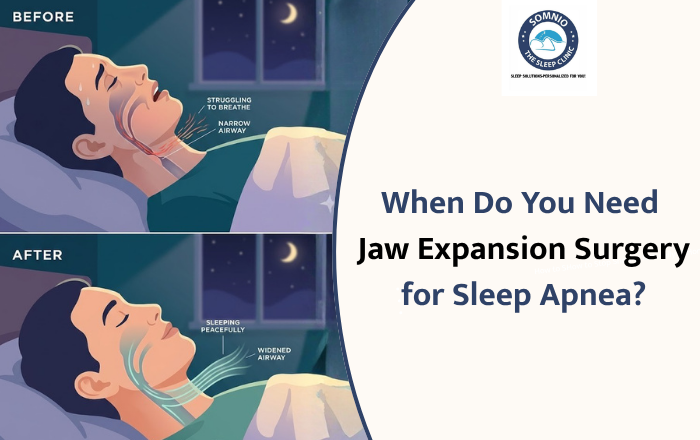
Most people think sleep apnea is simply about snoring. But for many patients, the real cause is a narrow or recessed jaw that physically blocks the airway during sleep. When that’s the case, no amount of lifestyle changes or CPAP therapy fully solves the problem. That’s where jaw expansion surgery for sleep apnea comes in.
Let’s break down everything you need to know — in plain, simple language.
What Is Jaw Expansion Surgery for Sleep Apnea?
Jaw expansion surgery for sleep apnea — often referred to as Maxillomandibular Advancement (MMA) — is a surgical procedure that moves the upper and lower jaw forward. This creates more physical space at the back of the throat, keeping the airway open while you sleep.
Think of your airway like a garden hose. If the hose is kinked or squeezed, water can’t flow freely. A narrow or underdeveloped jaw essentially “kinks” your airway every time you lie down. Jaw expansion surgery straightens that kink — permanently.
Studies show that MMA surgery has a success rate of 85–90% in treating obstructive sleep apnea, making it one of the most effective surgical solutions available.
7 Signs You Might Need Jaw Expansion Surgery
Not everyone with sleep apnea needs surgery. But there are clear signs that suggest it could be the right path for you:
- CPAP isn’t working for you. Nearly 50% of CPAP users stop using their machine within the first year. If you’ve genuinely tried CPAP and still feel exhausted, your airway issue may be structural.
- You have a small or recessed jaw. If your lower jaw sits further back than it should, your airway is naturally narrower — especially when your muscles relax during sleep.
- Your sleep apnea is moderate to severe. Mild cases may respond to oral appliances or positional therapy. Severe cases often require a more lasting solution.
- Oral appliances haven’t helped. These devices work for many people, but when jaw anatomy is significantly abnormal, appliances can only do so much.
- Your sleep study shows serious airway collapse. If your airway is repeatedly and completely collapsing during sleep, structural correction becomes a real consideration.
- You’re healthy and want a permanent fix. Jaw expansion surgery for sleep apnea is a one-time procedure for most patients — not a nightly routine.
- Your daily life is suffering. Chronic fatigue, poor concentration, mood changes, and relationship strain are all signs that your current treatment isn’t enough.
Who Is a Good Candidate?
The ideal candidate for jaw surgery for sleep apnea is generally an adult whose facial growth is complete (usually after age 18), with moderate to severe obstructive sleep apnea and a jaw structure that contributes to airway narrowing.
A thorough evaluation — including a sleep study, dental models, and 3D imaging — helps determine whether surgery is truly the right fit. Your overall health, jaw anatomy, and previous treatment history all play a role in this decision.
What Does the Surgery and Recovery Look Like?
The process begins with a detailed consultation and diagnostic workup. Once your surgeon confirms you’re a suitable candidate, surgical planning begins using imaging and jaw models.
The surgery itself is performed under general anesthesia. Recovery involves some swelling and jaw stiffness for the first two to four weeks, but most patients return to light daily activity within two to three weeks. Full results — including improved sleep and breathing — are usually noticeable within three to six months.
Many patients also notice a subtle improvement in their facial profile, as moving the jaw forward often creates a more balanced appearance.
Jaw Surgery vs. CPAP — Which Is Right for You?
CPAP is effective when used consistently. But it works only while you’re wearing it. The moment you take it off, the problem returns. Jaw expansion surgery for sleep apnea, on the other hand, addresses the physical structure causing the issue so results last well beyond the operating table.
That said, surgery isn’t for everyone. The best approach is always a thorough evaluation with a qualified specialist who can review your specific anatomy and sleep study results before making any recommendation.
Take the Next Step Toward Real, Restful Sleep
If you’ve been struggling with sleep apnea and feel like you’ve exhausted your options, you haven’t. You may simply not have found the right solution yet.
At Somnio The Sleep Clinic in Filmnagar, Hyderabad, Dr. Sukhvinder Bindra — an experienced Oral & Maxillofacial Surgeon works closely with patients to assess whether jaw expansion surgery for sleep apnea is the right path forward. With a careful, patient-focused approach and deep surgical knowledge, Dr. Bindra helps patients finally get the uninterrupted, restorative sleep their bodies need.
Name – Somnio The Sleep Clinic – Sleep Apnea Snoring Specialist in Hyderabad
Address: Babu Mohan Empire, 8-2-293/82/F, Plot no, 21 C, Rd Number 9, Film Nagar, Hyderabad, Telangana 500096
Phone: 99631 11550
👉 Book your consultation today – because waking up refreshed shouldn’t feel like an impossible dream.